
🧠 The Syllabus: June 1, 2026
Welcome to The Syllabus, an AI in education newsletter experiment bringing together market signals, research, and policy. The mood this week: AI is becoming infrastructure, while guardrails grow.

Hi, I’m Angela Chen! I’m an edtech founder, Stanford instructor, and AI in education advisor. Every week, I read across the full AI-in-education landscape: research, classroom practice, startup and funding signals, policy, and market intelligence.
I’ve been doing this privately for my own work and a few people kept asking what I was tracking. So I’m sharing the signals I actually think matter, synthesized across everything I read that week, publically now!
If there’s something here worth going deeper on, comment below or DM me on LinkedIn and tell me which signal — I’m always interested in what’s actually landing for people in the field.
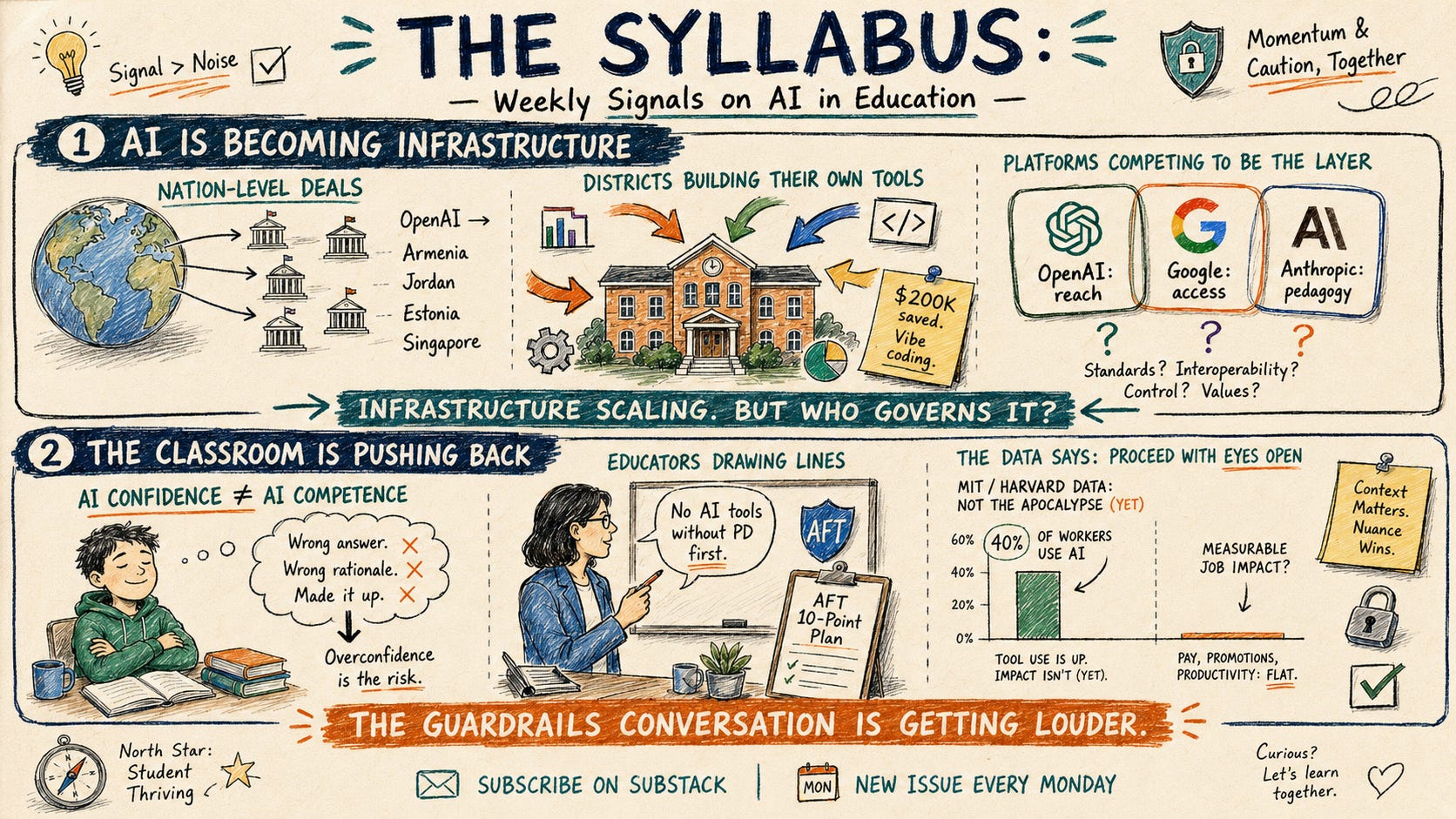
The mood this week is bifurcated: on one hand, AI is quietly becoming infrastructure — districts building their own tools, nations signing direct deals with OpenAI, universities positioning as innovation hubs. On the other hand, the guardrails conversation is getting louder and more organized, with teachers’ unions, researchers, and practitioners all pushing back on “AI confidence” that doesn’t translate to competence.
⚡ What to pay attention to right now
Districts are becoming their own edtech vendors and that’s a bigger deal than it sounds
An Oregon school district is projecting $200K in savings by using AI-powered “vibe coding” to build custom instructional tools in-house, according to EdWeek’s reporting from May 29. This isn’t an isolated story, it’s an early signal of a structural shift. When AI makes coding accessible enough that district IT teams can build custom solutions faster and cheaper than procuring from vendors, the traditional edtech sales model starts to crack.
For vendors, the response has to be products that are genuinely harder to replicate by district IT teams: deep integrations, compliance infrastructure, and curriculum-grade content. For districts, the question is sustainability — who maintains these tools when the initial savings wear off? This is a trend worth watching closely.
OpenAI is going country-direct and it’s reshaping who the edtech competition even is
Armenia is the latest country to sign on with OpenAI’s Education for Countries program, a direct government-to-OpenAI partnership to embed AI into national education infrastructure. This follows similar moves in other countries (Jordan, Greece, Kahzakstan, Slovakia, Singapore, and Estonia) and represents something the traditional edtech ecosystem wasn’t built to compete with: foundation model companies offering subsidized, integrated AI capacity at the national level.
The US doesn't have an equivalent counterpart — education is a state function, fragmented by district, and there's no federal body that could sign a comparable deal. The deeper competitive picture is that OpenAI isn’t the only one moving here — it’s just moving most visibly. Google is winning on access by embedding Gemini directly into Workspace for Education tools millions of schools already use: no new procurement, no friction, already there. Anthropic is taking a different approach entirely — its Teach For All partnership puts teachers as co-architects of AI tools across 63 countries rather than recipients of them.
I’m writing a longer piece on what this three-way divergence actually means for the field. The short version: OpenAI is winning on top-down reach, Google on educator access, Anthropic on pedagogical intentionality — and which of those bets pays off will depend entirely on whether outcomes data ever catches up to deployment speed.
The American Federation of Teachers just drew a hard line and it’s going to shape district procurement decisions
The American Federation of Teachers released a comprehensive AI plan this week calling for complete screen bans for pre-K through grade 2, bans on student-facing AI tools across all of elementary education, and substantial teacher training requirements as a precondition for any AI tool adoption.
Whether or not you agree with the specific policy asks, the signal is clear: labor unions are now becoming a formal stakeholder in edtech procurement decisions, not just an afterthought. Districts that want smooth implementation need union buy-in, and union buy-in increasingly means credible PD infrastructure — not pilot programs and slide decks.
New research: student AI confidence is inversely correlated with AI competence
AI for Education’s May 28 newsletter flags a new study on middle schoolers showing that students who are most confident using AI tools actually perform worst — they can’t distinguish good AI outputs from bad ones and rarely ask follow-up questions. This is a classic “confidence trap” problem and it has direct implications for how we design AI literacy curricula. Familiarity with tools is not the same as understanding of their limitations. The practical implication for K-12: AI literacy programs that focus on tool access without building critical evaluation skills may actually widen the competency gap rather than close it.
MIT/Harvard data on AI and jobs: grounding the workforce narrative
MIT Technology Review’s June 1 issue digs into the actual Bureau of Labor Statistics data and Harvard economist David Deming’s longitudinal survey tracking AI adoption across the workforce and found that AI hasn’t had large-scale labor market impact yet. About 40% of workers use generative AI, productivity gains exist but aren’t economy-shaking, and unemployment in AI-exposed occupations is actually lower than in less-exposed ones.
This matters for how we talk to students, parents, and district leaders about workforce preparation. The honest answer right now is not “AI is killing jobs” but “AI is changing the skills that matter, and we don’t have great data yet on what comes next.”
🛠️ Tools of note
(These aren’t startup investment recommendations — they show up here because they’re connected to trends worth tracking.)
AI for Education’s 45-Hour Practitioner Course — “Generative AI in Your Practice: From Knowledge to Application” — a self-paced course for educators launching June 1
Why it’s trending: This is one of the most substantial educator AI literacy infrastructure I’ve seen built to date. The move from micro-credentials to a full 45-hour course reflects that surface-level PD is no longer sufficient — both practitioners and districts are demanding depth.
EDSAFE AI Policy Essentials Course — A free, 10-module self-paced course (~3.5 hours total) built specifically for district leaders: superintendents, school board members, CTOs, and policy committees.
Why it’s trending: It’s a direct response to the governance gap the AFT plan and CoSN data both flagged this week — most districts have acceptable use policies that weren’t built for generative AI, and leaders lack practical frameworks for procurement decisions, vendor accountability, and data privacy. This is the structured infrastructure for that. Worth sharing with any district leader you’re advising.
💰 Funding & market moves
HolonIQ’s $200M Partnership for Health, Education & Economic Mobility — HolonIQ flagged a new $200M cross-sector partnership connecting health, education, and economic mobility in their May 29 ecosystem hubs report. The broader HolonIQ report on Edtech Ecosystem Hubs is worth reading: it maps how universities are showing up at every stage of edtech innovation, from R&D through commercialization to adoption — and argues they’re underutilized as infrastructure for the sector.
📚 Research & policy on my radar
“Student AI Confidence Hides Real Gaps” — AI for Education (mentioned above)
A study tracking middle schoolers found that confidence with AI tools doesn’t translate to competence and may make things worse. Students with the most positive AI attitudes performed worst, couldn’t distinguish good from bad AI outputs, and rarely asked follow-up questions. This means K-12 AI literacy programs that emphasize access and familiarity over critical evaluation are potentially counterproductive — so build for for skepticism, not enthusiasm.
“AI Isn’t Killing Jobs (Yet)” — MIT Technology Review, June 1
The data from BLS and Harvard’s longitudinal survey shows AI adoption is broad but economic impact is modest and job displacement is not yet measurable at scale. The piece argues that workforce AI preparation should focus on judgment, adaptability, and critical AI use — not fear. The skills gap is real, but it’s not the apocalypse narrative, and teaching to panic helps no one.
“Governing Generative AI in Higher Education” (new publication) — AI Edu Simplified / Substack, May 29
A new collaborative publication on AI governance frameworks for higher ed. Governance decisions flow will downstream to K-12 too and the frameworks colleges adopt now for student AI use, academic integrity, and data privacy will shape what K-12 districts face in three to five years.
That’s The Syllabus for this week. Lot’s to dig into!
If this was useful:
📬 Subscribe on Substack — The Syllabus will land in your inbox every Monday. I also write there on an ad hoc basis when something in the field deserves a longer take.
🔗 Connect with me on LinkedIn — I post on AI in education, edtech market signals, and what I’m seeing on the ground from my advisory work.
If you’re working on something in this space:
I advise school districts building AI frameworks and edtech founders navigating the K-12 market. If you’re doing either of those things and want a thought partner, reach out.
If you know someone who should be reading this:
Forward it. Re-stack it. Share it on Linkedin. The best readers I’ll ever have are probably in someone else’s inbox right now.